An import adds or updates many items at one time from a spreadsheet. Each row of the spreadsheet is one item. You select the type of content, upload the file, match the columns to the fields, and then start the import.
An export puts the content of a list or a report into a file. Some exports have the same columns as the import, so you can change the file and import it again. You can also copy selected items to another event.
To open the import, click Import Content under Related Resources in the CMS menu. You can also click Import and then Excel on a content list, for example on Info. Then the CMS selects the type and the menu item for you.
Each manager of the event can open the import. To export a list or to copy items to another event, you need the Export Content permission. To export a report, you need access to the reports. See Roles and Reports.
Templates
The CMS has no template file to download. Use one of these ways to make the header row:
- To add new items, type the field names of the type in row 1. Find the names in Types of content. A header that is the same as a field name selects the field for you on the Map Fields screen.
- To change items that you already have, export the list to Excel. Change the cells, and then import the file. The export has the current values, and the ID where the type has one, so the CMS updates the same items. See Import an export again for the columns to check.
For new content, you can also export an empty or short list and use its header row. Delete the rows that you do not want to change.
These types have no list export with import columns: Meeting, Post, and ScheduledEvent. Type the field names for them.
Prepare the file
- Use an Excel file (.xlsx). The CMS also reads a .csv file.
- Put the column headers in row 1. The CMS reads the data from row 2.
- Put one item in each row.
- To put more than one value in a cell, for example more than one participant type, separate the values with
|. - To skip a column, start its header with
Ignore:orIGNORE:. - The CMS also reads hidden columns and hidden rows. Delete the columns that you do not want to import, or start their headers with
Ignore:. - Delete empty rows and columns at the end of the sheet. If an Excel sheet spans more than 5,000,000 cells, the CMS imports no items and shows a message that the file is too large to import.
The CMS removes HTML tags and extra spaces from the headers. It also removes text in parentheses, so the header Title (required) reads as Title.
Dates and times use the event time zone. A date with dots and a time, for example 12.11.2026 09:00, reads as day, month, year. For yes or no fields, use yes, y, true, t, or 1 for yes, and no, n, false, f, or 0 for no.
The CMS has no template file to download. To get the right headers, see Templates.
Start an import
- Open Import Content. The New Resource Import form opens.
- Select the Resource type, for example
Info. - Select the Feature: the menu item that gets the content. When the event has no menu item of this type, the CMS shows There are no features of this type to choose from. Maybe add some? Some types do not need a menu item. See the list below.
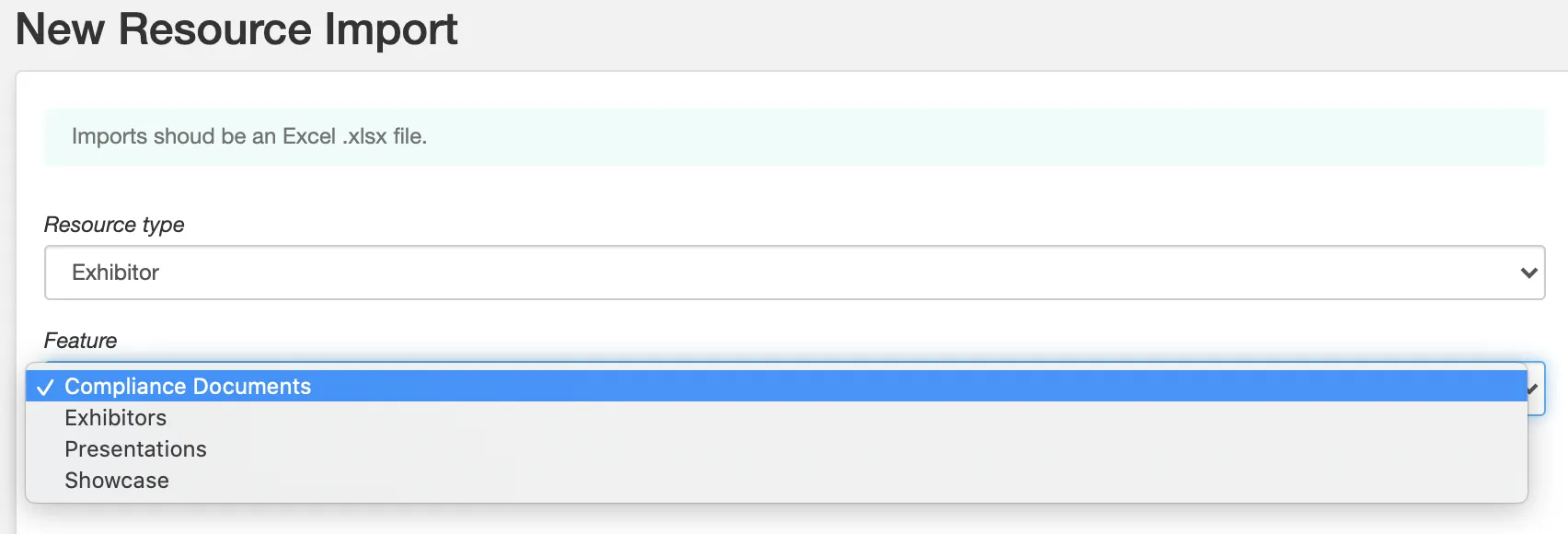
- Select Upload a new file and select the file. Or select Choose an existing file and select a file from your Secure files.
- Click Save.
If the CMS cannot start the import, it shows the problem at the top of the form. For example:
- Must select either an existing or new file.
- Resource type must be present.
- Feature can’t be blank.
When you upload a new file, the CMS keeps it in Secure files.
Match the columns
The Map Fields screen opens.
- If the file has more than one sheet, select the sheet in Select Sheet.
- For each column header, select the field that gets the values of the column. The CMS selects a field when the header is the same as the field name. Capital letters do not matter, and an underscore counts as a space. Select
** IGNORE **to skip a column. - If your organization uses a data service for this type, you can select the Skip check box with the name of the service. The CMS then does not get more data from that service. The next screen shows Will NOT fetch from and the name of the service.
- Click Confirm.
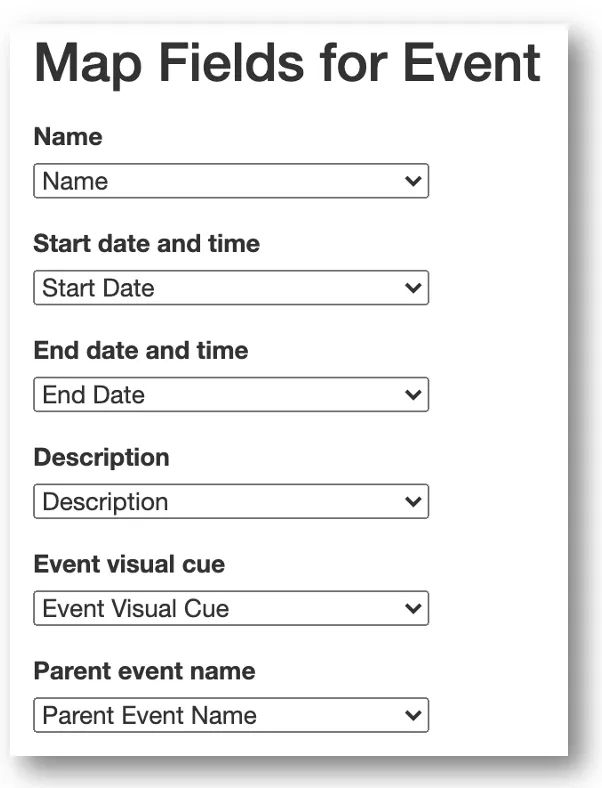
The field list has these groups, when the type uses them:
- Fields: the fields of the item.
-
Custom Fields: the custom fields of the menu item, for example
Custom Field: Dietary needs. -
Groups:
Group Header:and a group name puts the values of the column into that group as terms.Group Header: CREATE NEWuses the group with the name of the column header, withoutGroup Header:. The CMS makes the group if it does not exist. The CMS makes the terms that do not exist. Separate more than one term in a cell with the|character. See Groups. -
Related Links:
Related Link: CREATE NEWadds the value of the column as a related link. The text after the:in the column header is the link title, for exampleRelated Link: Slides. When there is no such text, the title is “Presentation”. Start the link title or the cell with[external]to open the link in an external browser.
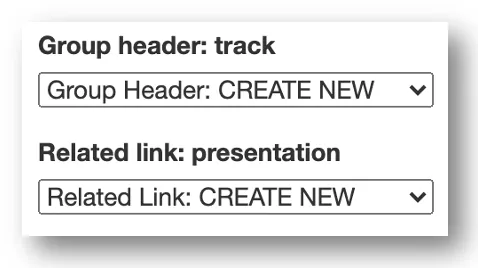
A header such as Custom Field: Dietary needs or Group Header: Region is the same as the name in the list, so the CMS selects that custom field or group for you. A header with only the group name or the custom field name does not match. Select the item yourself.
Confirm and import
The Confirm Import screen shows each column and its field. It also shows the Groups, Custom Fields, and Related Links columns, and the columns under Will Not Import.
Click Import. The Results of your CSV Upload screen opens. It shows Processing and the number of items that the CMS imported. The screen updates every 10 seconds.
When the import is complete:
- If there are no errors, the screen shows Congratulations! Your import completed successfully without reported errors.
- If rows have errors, the screen shows each row number with its errors. The CMS does not import a row with an error.
- If the Excel sheet is too large, the screen shows the size message, and the CMS imports no items.
Click Export to download a CSV file of the errors and warnings. The file has a row index column and one column for each kind of message. A warning does not stop a row. If you see Export but no errors, you can ignore the file.
To see your earlier imports, click Cancel on the New Resource Import form. The Resource Imports list shows the type, the person who started the import, and the date. Click an import to see its results. Click New to start another import.
Types of content
The Resource type list has the types below. For each type, this section gives the fields in the Fields group, the other headers that the CMS matches, and how the CMS finds an item to update. When the CMS finds no item, it adds a new one.
The Id of an Attendee, Event, Info, Location, or Post row must belong to an item of this event. If it does not, the row shows an error. When you import a file that you exported from another event, select ** IGNORE ** for the Id column.
For the people types, the CMS uses Participant Types to replace the participant types of the item. It uses Participant Types Additional to add types and keep the old ones. The CMS makes the participant types that do not exist. See Participant types.
Attendee
Needs a menu item. See Attendees.
Fields: Biography Html, Biography Text, Birthday, Display City, Display Country, Display Email, Display State, Display Street, Display Street2, Display Telephone, Display Zip, Exhibitor, External, Facebook Username, Find Strategy, First Name, Full Name, Hidden, Id, Instagram, Job Title, Last Name, Lead Address, Lead City, Lead Code, Lead Country, Lead Email, Lead Phone, Lead Postal Code, Lead State, Lead Street1, Lead Street2, License, Login Email, Middle Name, Organization, Participant Types, Participant Types Additional, Password, Photo Upload Url, Prefix Name, Private Messages, Question, Social Media Facebook, Social Media Instagram, Social Media Linked In, Social Media X, Suffix Name, Website, and X Handle.
Other headers that match: First, Last, Prefix, Suffix, Avatar Url, Photo Url, Display Street 2, Bio, Email, Twitter, Twitter Handle, LinkedIn Url, Linked In Url, Facebook Url, X Url, and Instagram Url.
Also uses: Groups, Custom Fields, and Related Links.
-
Externalis the external ID of the attendee. -
Middle Nameadds to the first name.Full Namesplits into the name fields. -
Exhibitoradds the attendee to the staff of the exhibitor with that name. If no exhibitor has that name, the row shows Could not match exhibitor with name and the name. -
Passwordsets the app login password of the attendee. -
Lead Codesets the badge code. An empty cell keeps the old code. A new attendee gets a code. A code must have at least one letter or digit. It must not contain,,|, or#, and it must be unique in the event. -
X Handle,Facebook Username, andInstagrammake a full social media address from a user name. - The CMS checks the
Photo Upload Urladdress. If the address does not answer, the row gets a warning.
How the CMS finds the attendee: by Id when the row has it. If not, by Login Email with the first and last name, then by the login email alone. Then by External, then by first name, last name, and job title, then by first name, last name, and organization, then by first and last name. If the login email matches an attendee with a different first or last name, the CMS adds a new attendee. If two rows match the same attendee with different login emails, the second row shows an error.
Event
Sessions. Needs a menu item. See Sessions. On the New Resource Import form, the Feature list shows only Agenda menu items. For another sessions menu item, click Import and then Excel on its session list.
Fields: Capacity, Capacity Constrained, Check In Code, Check In Type, Description, Description Part, Education Credits, End Date, Event Visual Cue, External, External Speaker Ids, Id, Image Link, Image Upload Url, Location Name, Name, Parent Event Name, Participant Types, Participant Types Additional, Registration Required, Speaker Names, Start Date, Survey Name, Time Zone, and Tracks.
Other headers that match: Title, Start, End, Start Date And Time, End Date And Time, Starts At, Ends At, Speakers, Location, Parent, Parent Event, Parent Session, Room Or Booth Name, Header Image Url, Image Url, Image Link Url, Header Link, and Header Link Url.
Also uses: Groups and Related Links.
-
Location Nameconnects the session to the location with that name. The CMS makes the location if it does not exist. -
Speaker NamesandExternal Speaker Idsreplace the speakers of the session. The CMS makes a speaker for a name that does not match a speaker. An external ID that does not match a speaker gives an error. -
Education Creditssets the credit amounts of the session. Put the credit type and the amount in the cell, for exampleCEU: 1.5 | CME: 2. You can also separate the pairs with a comma, for exampleCEU: 1.5, CME: 2. Or use the credit type as the column header and the amount in the cell. The credit type must exist. -
Survey Nameconnects a survey with that name. The CMS makes the survey if it does not exist. -
Tracksadds the session to the tracks. The CMS makes the tracks that do not exist. -
Parent Event Nameputs the session under a parent session with that name. The CMS makes the parent session if it does not exist.
-
Event Visual Cueisworking,social,poster,food,break,breakout, ornone. Capital letters do not matter. Other values give an error. -
Check In TypeisUnverified,Scan,Code,Time Bounded,Code And Time Bounded, orNone. Capital letters do not matter. See Set the check-in rules. -
Time Zonesets a time zone for the session only. Use a time zone name, for exampleEastern Time (US & Canada)orAmerica/Chicago. Another value gives an error.

How the CMS finds the session: by Id when the row has it. If not, by the name and start time, and by the parent session when the row has one.
Exhibitor
Needs a menu item. See Exhibitors.
Fields: Admin Email, Admin Name, Check In Code, Check In Type, Contact Name, Description, Display City, Display Country, Display Fax, Display State, Display Street, Display Street2, Display Telephone, Display Zip, Email, Exhibitor Header Remote Url, Exhibitor Icon Remote Url, External, Facebook Username, First Name, Hidden, Instagram, Last Name, Leads Enabled, Location Name, Name, Participant Types, Participant Types Additional, Social Media Facebook, Social Media Instagram, Social Media Linked In, Social Media X, Sponsor Level, Ticker, Website, and X Handle.
Other headers that match: Location, Booth Name, Room Or Booth Name, Code, Contact Email, Descrip, Telephone, Address, City, State, Zip, Icon Url, Header Url, and the social media headers of the attendee type.
Also uses: Groups and Related Links.
-
Display Street,Display Street2,Display City,Display State,Display Zip, andDisplay Faxgo into the top of the description. -
First NameandLast Namemake the contact name whenContact Nameis empty. -
Sponsor Levelsets the sponsor level with that name. The CMS makes it if it does not exist. -
Location Nameconnects the exhibitor to the location with that name. The CMS makes the location if it does not exist.
How the CMS finds the exhibitor: by an exhibitor of the same menu item whose name contains the Name value. Capital letters do not matter.
Info
Needs a menu item. See Info.
Fields: Body, Id, and Name. Other headers that match: Title. Body can hold HTML. The CMS removes HTML that is not safe, as in the text editor. When the body has no <br> or <p> tag, each line break becomes a line break in the app.
How the CMS finds the item: by Id when the row has it. The item must be in the selected menu item, or the row shows an error. If not, by the exact Name in the menu item. Two rows with the same name update the same item. Give each row its own name.
Link
Needs a menu item. See Links.
Fields: Description, File, Icon Upload Url, Name, and Url. Other headers that match: Title and Link.
-
Fileis the address of a file. The CMS downloads the file into the link. -
Icon Upload Urlis the address of an image. The CMS downloads it as the icon.
How the CMS finds the link: by the exact Name in the menu item. Two rows with the same name update the same link. Give each row its own name.
Location
Does not need a menu item. See Locations.
Fields: City, Country, Expofp Feature, Expofp Location, Id, Name, State, Street, Url, and Zip. Other headers that match: Title and Expofp Feature Id.
-
Expofp Locationmarks the location as a booth on an ExpoFP floor plan. A yes value uses the location name as the booth. Any other text is the booth name. The CMS sets theUrlof the location to a link that opens the floor plan at that booth. See ExpoFP map. -
Expofp Featureis the number of the ExpoFP map menu item. You need it when the event has more than one ExpoFP map. If it is missing, the row shows ExpoFP Feature Id is required: this gathering has more than one ExpoFP Map feature.
How the CMS finds the location: by Id when the row has it. If not, by the exact Name.
Meeting
Private meetings with participants. Does not need a menu item. See Meetings.
Fields: Description, End Date, Location Name, Name, Participant Email, and Start Date. Other headers that match: Start, End, Start Date And Time, End Date And Time, Location, Room Or Booth Name, and Meeting Name.
Participant Email adds the attendees or speakers with these login emails to the meeting. Separate the emails with |. If no attendee or speaker has an email, the row shows an error. Location Name connects the meeting to the location with that name. The CMS makes the location if it does not exist.
How the CMS finds the meeting: by the name and start time of a private meeting.
NewsStory
Announcements. Needs a menu item: select it in Feature. See Announcements.
Fields: Body, Event, Id, Participant Types, Publish At, Push, Push Message Text, Summary, and Title.
-
Eventis the number of a session. Only attendees with this session on their schedule or in their favorites get the announcement. - A column with the name of an attendee group sets the terms of that group as a filter. The terms must exist.
-
Publish Atschedules the announcement. A new row without it makes a draft. -
Pushturns on the push notification. - The CMS changes
Event,Participant Types, the group terms,Publish At, andPushonly when the announcement is not published.
How the CMS finds the announcement: by Id when the row has it. If not, by the exact Title in the menu item. Two rows with the same title update the same announcement. Give each row its own title.
The CMS does not import the Status and Published At columns of the announcements export.
Post
Posts by the event. Needs a menu item: select a discussion board item in Feature. See Activity feed.
Fields: Id, Participant Types, Scheduled At, and Text. Other headers that match: Post Text, Post Date, and Display At.
The event is the author of each post. Scheduled At is the time the post shows.
How the CMS finds the post: by Id only. A row without Id makes a new post.
ScheduledEvent
Adds sessions to the schedules of attendees. Does not need a menu item.
Fields: Attendee External, Change Action, Description, End Date, Event External, Event Name, First Name, Id, Job Title, Last Name, Location Name, Login Email, Organization, Parent Event, Personal Itinerary Information, Private Event Name, and Start Date. Other headers that match: First, Last, Company, Email, Start Time, End Time, Start Date And Time, End Date And Time, and Location. The CMS selects Personal Itinerary Information for most other headers.
Also uses: Groups.
-
With
Event NameorEvent External, the CMS adds the session to the schedule of the attendee.Change Actionmust beadd,include,drop, orremove.dropandremovetake the session off the schedule. -
With
Event Name, the CMS finds the session by its name, and byStart Datewhen the row has it. When more than one session matches, the row shows an error. UseEvent Externalor addStart Date. -
With
Private Event Name, the CMS makes a private session for the attendee, with the start time, end time, description, and location of the row. WithId, the CMS updates that private session. -
With
Parent Event, put the name of the parent session in the cell. You can add|and its start time. EachPersonal Itinerary Informationcell is the name of a session in that parent session, and the CMS adds it to the schedule. -
Without these fields, each
Personal Itinerary Informationcolumn header is the name of a parent session. You can add|and its start time. Each cell is the name of a session in that parent session.
-
If the CMS cannot find a session, the row shows an error. The session names and the parent session names must be the same as in the agenda, with the same capital letters, punctuation, and spaces between words.
How the CMS finds the attendee: in the same order as for Attendee, but without Id. Attendee External is the external ID. If the CMS finds no attendee, it adds one.
ScheduledMessage
Messages that the event sends at a set time. Does not need a menu item. See Messages.
Fields: Body, Deliver At, Event, Id, Participant Types, Push Notification, Recipient Email, State, and Subject.
-
Recipient Emailsends the message to the attendee with this login email. Put one email in the cell. If no attendee has it, the row shows Recipient was provided but was not found. -
Eventis the number of a session. -
Stateisdraftorqueuedfor a new message. Other values make a draft. A row withqueuedand aDeliver Atin the past sends in the next few minutes.
How the CMS finds the message: by Id only.
Speaker
Does not need a menu item. See Speakers.
Fields: Biography, Display City, Display Country, Display Email, Display State, Display Street, Display Street2, Display Telephone, Display Zip, External, Facebook Username, First Name, Full Name, Instagram, Job Title, Kind, Last Name, Login Email, Logo Upload Url, Middle Name, Organization, Participant Types, Participant Types Additional, Password, Photo Upload Url, Prefix Name, Self Assignable Moderator, Social Media Facebook, Social Media Instagram, Social Media Linked In, Social Media X, Suffix Name, Visibility, Website, and X Handle.
Other headers that match: First, Last, Prefix, Suffix, Photo Url, Bio, Email, and the social media headers of the attendee type.
-
Visibilityisalways,session, orhidden. Other values makesession. -
PasswordwithLogin Emaillets the speaker log in to the app with this password. If the person already has an app login, the CMS keeps the old password.
How the CMS finds the speaker: the same as for Attendee, without Id.
Survey
Survey questions. Does not need a menu item. See Surveys.
Fields: Correct Answer, Name, Participant Types, Question Data, Question Type, and Survey Name. Other headers that match: Title (the survey name), Question Name, and Question (the question).
- Each row is one question. The CMS adds it to the survey with the
Survey Name, and makes the survey if it does not exist. -
Participant Typessets the participant types of the survey. -
Question Typeischoice,comment, orrating, in lower case. Other values show Invalid question type (choice, comment, rating) for and the question. - A
choicequestion needsQuestion Data: the answer options, separated with|. Without it, the row shows must have question data (options).
Video
Needs a menu item. See Videos.
Fields: Description, External Url, Name, and Source Upload Url. Other headers that match: Title and Link.
How the CMS finds the video: by the exact Name in the menu item. Two rows with the same name update the same video. Give each row its own name.
This article is a copy of Imports and exports in the Touchpoint documentation.
Comments
0 comments
Please sign in to leave a comment.